Tax Benefits & Capital Gains Rules When You Buy or Sell a Residential Plot in India (2026 Comprehensive Advisory)
Investing in real estate has long been India’s premier wealth-building strategy. However, navigate the tax maze incorrectly, and a huge chunk of your land appreciation can evaporate in income tax liability. Whether you are purchasing a freehold land parcel in a rapidly appreciating zone like garhmukteshwar near Ganga Expressway or selling existing property to reinvest, understanding the Income Tax Act nuances is paramount.
A common misconception among property investors is treating plot purchases identical to buying constructed apartments. In truth, the Indian Income Tax law draws sharp distinctions between buying vacant land versus constructed residential units, particularly concerning home loan tax deductions, Long-Term Capital Gains (LTCG), Short-Term Capital Gains (STCG), and exemption claims under Section 54F and Section 54EC.
Looking to Reinvest Capital Gains in High-Growth Western UP Plots?
Explore legal, RERA-compliant, freehold residential plots at Ganga Residency garhmukteshwar. Maximize capital growth while saving taxes via Section 54F construction benefits!
Check Ganga Residency Plot Price List & Tax Saving Options →
Table of Contents (Tax & Capital Gains Master Index)
- STCG vs. LTCG: Holding Periods & Tax Rates
- Tax Benefits When Buying a Residential Plot
- Section 54F Exemption: Saving LTCG via Plot Construction
- Section 54EC Capital Gain Bonds Explained
- Capital Gains Account Scheme (CGAS) Guidelines
- Section 80C Tax Savings on Stamp Duty
- Plot vs. Built House Tax Benefit Matrix
- Frequently Asked Tax Questions
1. STCG vs. LTCG: Holding Periods & Tax Rates for Land in India
When you sell a residential plot in India, the profit generated is classified under Capital Gains. The tax treatment hinges strictly on the holding period (the duration between the registration date of purchase and the date of sale transfer).
CRITICAL TAX RULE CHANGE:
Under Indian tax laws applicable for real estate, immovable property such as residential plots transitioned to a 24-month threshold for distinguishing short-term from long-term capital assets.
- Short-Term Capital Asset (Holding Period ≤ 24 Months): If you sell your residential plot within 24 months of purchase, profits are treated as Short-Term Capital Gains (STCG). These gains are added directly to your taxable income slab rate (which could reach up to 30% plus applicable surcharge and cess). No indexation benefits or Section 54 exemptions apply to STCG.
- Long-Term Capital Asset (Holding Period > 24 Months): Holding your plot for more than 2 years classifies the profit as Long-Term Capital Gains (LTCG). Under updated real estate tax provisions, taxpayers can evaluate their tax liability based on the latest tax budget revisions, providing flat lower tax brackets or indexation benefits depending on acquisition date benchmarks.
Why Hold Your Plot Beyond 24 Months?
Holding a land parcel in prime developing corridors such as plots near Ganga Expressway beyond 24 months unlocks immense legal tax relief. Long-term assets allow investors to utilize Sections 54F, 54EC, and CGAS schemes to legitimately reduce taxable capital gains to zero.
2. Tax Benefits When Buying a Residential Plot (Plot Loan vs. Home Loan)
Many buyers assume that taking a bank loan to purchase a vacant plot grants immediate Income Tax deductions under Section 24(b) (interest repayment) and Section 80C (principal repayment). However, tax authorities distinguish between a Plot Loan and a Home Construction Loan.
Key Tax Conditions for Plot Purchases:
- No Direct Deduction on Vacant Plot Loan: You cannot claim tax deductions on a loan taken solely to purchase a vacant plot of land if no residential house is constructed on it.
- Composite Plot-plus-Construction Loan Benefit: If you take a composite loan to purchase a plot at Ganga Residency AND construct a residential villa within the stipulated bank timeframe, tax deductions become active after construction completion.
- Pre-Construction Interest Deduction: Interest paid during the plot purchase and construction phase can be accumulated and claimed in 5 equal annual installments starting from the financial year in which home construction completes, up to the maximum limit of &naira;2,000,000 under Section 24(b) for self-occupied properties.
3. Section 54F Exemption: How to Save LTCG by Building a Villa at Ganga Residency
Section 54F of the Income Tax Act is an invaluable tax strategy for smart real estate investors. If you have sold long-term assets such as shares, gold, commercial property, or another plot, and wish to avoid paying 20% LTCG tax, Section 54F lets you claim full tax exemption by investing the net sale consideration into a residential house property.
SECTION 54F ELIGIBILITY MANDATES:
- The taxpayer must not own more than ONE residential house (other than the new asset) on the date of sale transfer.
- You must purchase a residential house within 1 year before or 2 years after the transfer date OR construct a residential house within 3 years from the transfer date.
- Purchasing a freehold plot at Ganga Residency garhmukteshwar and completing villa construction within 3 years satisfies Section 54F requirements!
By choosing a plot in a well-planned township like Ganga Residency, buyers can design custom 3 BHK or 4 BHK villas, satisfy the 3-year construction completion mandate of Section 54F, and secure 100% legal tax exemption while building a high-yielding real estate asset. Check layout options in our 100 sq. yd vs 150 sq. yd plot size comparison.
4. Section 54EC Capital Gain Bonds Explained
If you sell a residential plot that has been held long-term (> 24 months) and do not wish to construct a house immediately, Section 54EC provides an alternative tax shelter through specified financial bonds:
- Eligible Issuers: National Highways Authority of India (NHAI), Rural Electrification Corporation (REC), Power Finance Corporation (PFC), or Indian Railway Finance Corporation (IRFC).
- Investment Window: Capital gains must be invested in 54EC bonds within 6 months from the date of land sale transfer.
- Maximum Cap: Maximum exemption investment limit is &naira;50 Lakhs per financial year.
- Lock-in Period: Bonds carry a mandatory 5-year lock-in period with annual interest payouts.
5. Capital Gains Account Scheme (CGAS) Guidelines
What happens if you sell a property in January and your Income Tax Return (ITR) filing deadline is July 31, but you haven’t finished buying your new plot or constructing your house yet?
Under Section 54 / 54F rules, if the capital gains net consideration is not fully utilized before the ITR filing due date (typically July 31 of the relevant Assessment Year), you must deposit the unutilized funds into a Capital Gains Account Scheme (CGAS) with a authorized public sector bank. Depositing funds in CGAS keeps your tax exemption claim valid while you execute plot purchase and villa construction at Ganga Residency Master Plan Layout.
6. Section 80C Tax Savings on Stamp Duty & Registration Charges
When registering your residential plot deed, stamp duty and registry charges constitute a significant upfront expense. Taxpayers can claim a tax deduction for payment of stamp duty and registration fees under Section 80C of the Income Tax Act up to the overall ceiling limit of &naira;1,50,000 for the financial year in which the payment was made.
Note on Section 80C Stamp Duty Claim:
To claim Section 80C benefits on plot stamp duty, the land must be intended for residential construction. Non-individual entities or commercial land purchases do not qualify under 80C personal income tax deductions.
7. Plot vs. Built House Tax Benefit Comparison Matrix
Here is a side-by-side feature matrix evaluating real estate tax provisions for vacant plot purchases versus constructed apartment/house purchases:
| Tax Provision / Benefit | Vacant Plot Purchase | Plot + Construction / Built House |
|---|---|---|
| Section 24(b) Interest Deduction | Not Available for plain land | Up to &naira;2 Lakhs/year post-construction |
| Section 80C Principal Deduction | Not Available | Up to &naira;1.5 Lakhs/year |
| Section 80C Stamp Duty Claim | Eligible in purchase year | Eligible in purchase year |
| LTCG Exemption via Sec 54F | Eligible if house built in 3 yrs | Directly Eligible upon purchase |
| LTCG Threshold Period | 24 Months | 24 Months |
| TDS under Sec 194-IA (Sale > 50L) | 1% TDS applicable | 1% TDS applicable |
Township Environment Walkthrough: Investing in Developed Plots
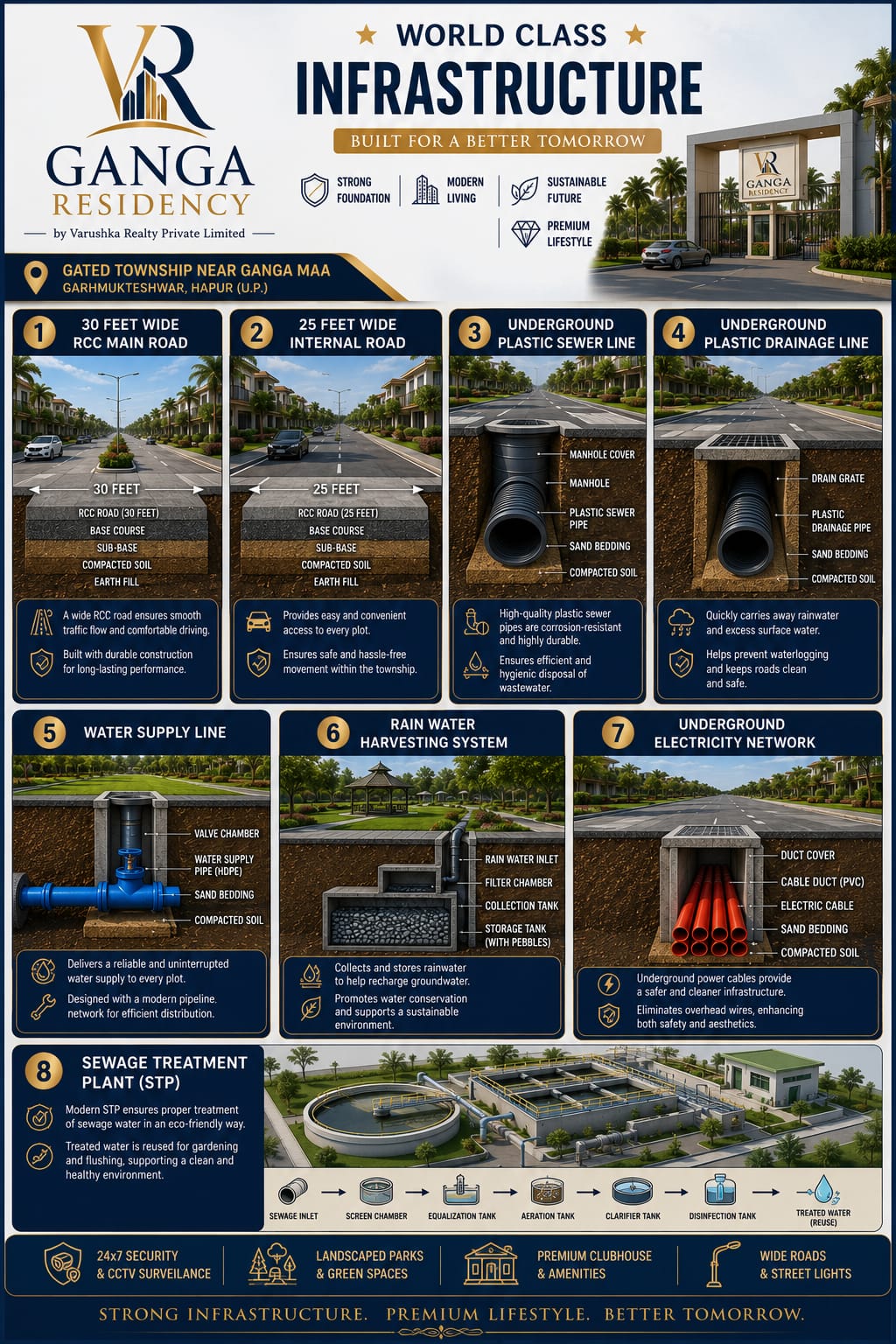
Selecting an approved township with underground utilities, wide roads, and immediate possession guarantees smooth bank loans, clear legal titles, and hassle-free tax audit compliance. Watch our township walkthrough video:

Watch Official Walkthrough: Developed Gated Township Infrastructure at Ganga Residency
Strategic Advantages of Investing in Ganga Residency garhmukteshwar
Beyond capital gains tax relief, purchasing a plot in garhmukteshwar delivers unmatched capital growth potential:
- Unbeatable Expressway Connectivity: Direct access via NH-9 and the newly expanding Ganga Expressway cuts travel time to Delhi NCR, Ghaziabad, and Noida to under 70 minutes. Read our full location and connectivity distance guide.
- High Appreciation Corridor: Western UP land values are witnessing 15–20% annual growth driven by infrastructure upgrades and spiritual tourism near sacred Garh Ganga. Explore price trends in our affordable plots under 20 lakhs breakdown.
- Clear Freehold Approvals: Ganga Residency offers freehold residential plots with pristine legal title checks. Compare approvals in our legal analysis on Section 143 land conversion rules.
- Sister Township Synergy: Explore surrounding development standards alongside Ganga County Plots.
8. Frequently Asked Questions (Tax & Plot Purchase FAQs)
Is TDS applicable when purchasing a residential plot in India?
Yes. Under Section 194-IA of the Income Tax Act, if the total sale transaction value of a plot equals or exceeds &naira;50 Lakhs, the buyer is legally obligated to deduct 1% TDS from the payment made to the seller and deposit it with the Income Tax Department using Form 26QB.
Can I claim Section 54F exemption if I buy a plot without constructing a house?
No. Section 54F strictly mandates that to claim long-term capital gains tax exemption on the net sale consideration of a non-house asset, a residential house MUST be constructed on the plot within 3 years from the asset transfer date.
How does Vastu compliance affect plot value and future re-sale tax planning?
Vastu-compliant rectangular plots command superior resale demand and faster liquidity in secondary markets, ensuring higher capital gains returns. Read our detailed Vastu-friendly plot layouts guide.
Can NRI investors claim tax exemptions on plot purchases in India?
Yes, Non-Resident Indians (NRIs) enjoy similar capital gains tax exemption rights under Section 54F and Section 54EC when investing in Indian residential land, provided transactions comply with FEMA guidelines and TDS under Section 195 is properly accounted for.
Recommended Tax & Real Estate Reading:
- Read our detailed guide on Top Reasons to Invest in Residential Plots in garhmukteshwar
- Compare pre-launch pricing strategies: Best Time to Book a Pre-Launch Plot
- External Investment Report: Why garhmukteshwar is Delhi NCR's Top Real Estate Hotspot (Medium)
- Buyer's Roadmap: Complete Ganga Residency Buyer's Guide 2026